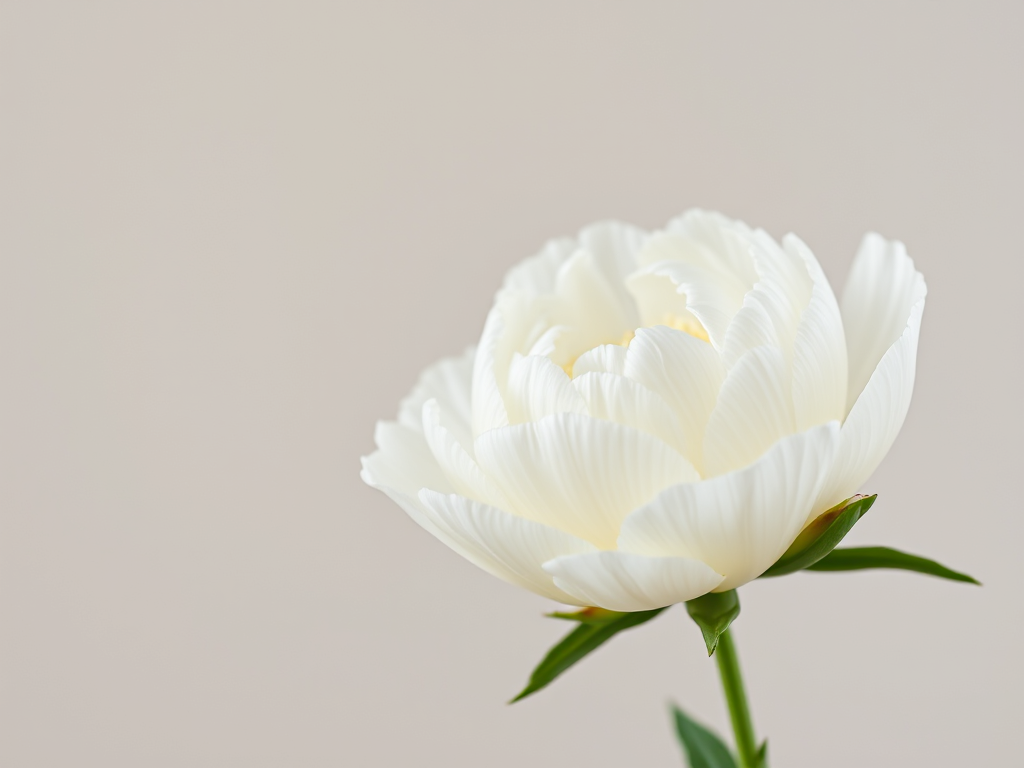
A Minister, Not a King
Classical Chinese horticulture assigned the peony family a court. The tree peony was named king of flowers; the herbaceous peony — jakyak in Korean, Paeonia lactiflora to botanists — was named minister of flowers. It sounds like a demotion. Spend a season with the plant and it reads instead as an unusually precise description.
The distinction is structural. A tree peony is woody: it holds its blossoms aloft on permanent branches, crowned and upright, the way a monarch is meant to sit. The herbaceous peony builds itself from nothing every spring. Its stems rise green from the crown of a root that has waited underground all winter, and at the tip of that soft new growth it sets a flower heavier than the stem was designed to carry. So the peony, at the moment of its full opening, bows. One rain and it bows further, until the blooms rest on the earth they came from.
Every culture that has looked closely at this flower has commented first on its posture — not its color, not its scent, but the angle of its head. Anyone who has carried an armful of peonies knows why. They are heavy. They tilt. They lean toward the person holding them.
Paeon, the Physician Who Became a Flower
The genus name descends from Paeon, physician to the gods in Greek myth. He healed wounds the Olympians took in battle, and his teacher Asclepius, jealous of the student's skill, moved to destroy him. Zeus intervened — not by hiding Paeon or arming him, but by turning him into a flower. It is a strange rescue: survival granted through transformation into something rooted and seasonal and mute.
The myth sits comfortably beside the plant's long medicinal life. Peony root has been among the most widely used materials in East Asian medicine for well over a millennium, prescribed to ease pain and release the tension held in muscle. The Chinese characters for the flower's name, 芍藥, contain the character for medicine outright. The blossom lasts days; the root lasts decades. A well-sited peony can outlive the person who planted it, and frequently does — old clumps mark the sites of vanished farmhouses across Korea, Europe, and the American Midwest, flowering above foundations that are no longer there.
The Korean Name
Korean has a second, older name for this flower: hambak-kkot. A hamjibak is a large round wooden bowl, hollowed from a single block of wood — the vessel a household kept for washing rice or holding grain. The flower was named for the bowl because a peony in full bloom is that wide and that round and that generous.
The same word appears in hambak-nun, the fat slow snow that falls in the largest flakes, and in hambak-useum, the widest laugh a face can make. Korean reaches for this one syllable whenever something is large and round and overflowing. That a peony blossom and a person's broadest smile share a name tells you the emotional register this flower has always occupied here. It is not a solemn flower. It is an abundant one.
The Way It Falls
The peony does not scatter. It lets go all at once.
Cherry blossoms drift down over days. Roses dry and curl inward, holding their shape past the end. The peony does neither. One morning, without warning, it releases every petal simultaneously, and what was a flower the night before is a heap of silk on the table. Gardeners describe standing still in front of this for some time.
That brevity is precisely why the peony became a flower for giving. It is not offered as a durable object. It is offered as a shared week. A peony arrives as a hard round bud, dense as a marble, and over the following days it opens — visibly, measurably, differently each morning — until it is wider than a hand. The recipient watches this happen in their own room, at their own kitchen table, and for those few mornings the flower is doing something. A peony gives away time, not an image of beauty.
Bashfulness and Abundance
Victorian flower dictionaries assigned the peony bashfulness, explained by a legend of fairies who hid inside the petals and by the plant's habit of dropping its head when it opens. East Asian tradition assigned it wealth, honor, feminine beauty, and the ache of parting. The two readings look contradictory — shyness and opulence — but they are the same observation from opposite sides. The peony is at its most extravagant precisely when it is least able to hold itself upright. True abundance does not announce itself. It bends.
This makes the peony the flower of people who are not fluent in saying things. The thank-you postponed too long to say plainly. The apology that has grown awkward with age. The congratulations so genuinely felt that speaking it aloud would be unbearable. For those sentences, nothing serves better than a bowl-sized bloom that says it by arriving.
Arriving While It Still Opens
With a flower this attentive to time, the day it reaches someone is part of what it says. Arrive in Bloom (flowername.co.kr) arranges every bouquet by hand in our atelier on the day it ships, so the stems leave us fresh. Order before 2 p.m. and we deliver nationwide the same day, with Jeju arriving the next. We write the recipient's name or your message on the ribbon in Korean or English calligraphy at no charge, and once the flowers are handed over we send you a photograph of them in place. Our concierge answers around the clock at 1666-6584. Send the buds while they are still closed — let the opening be your sentence.
'Flower Stories' 카테고리의 다른 글
| Same-Day Flower Delivery in Korea: Cutoff Times Explained (0) | 2026.08.25 |
|---|---|
| How to Send Flowers to Korea from Abroad: A Complete Guide (0) | 2026.08.25 |
| Forsythia: The Flower That Arrives Before Its Own Leaves (0) | 2026.08.24 |
| Calla Lily: The Leaf That Learned to Hold a Flower (0) | 2026.08.24 |
| Statice, or the Art of Keeping Color (0) | 2026.08.24 |