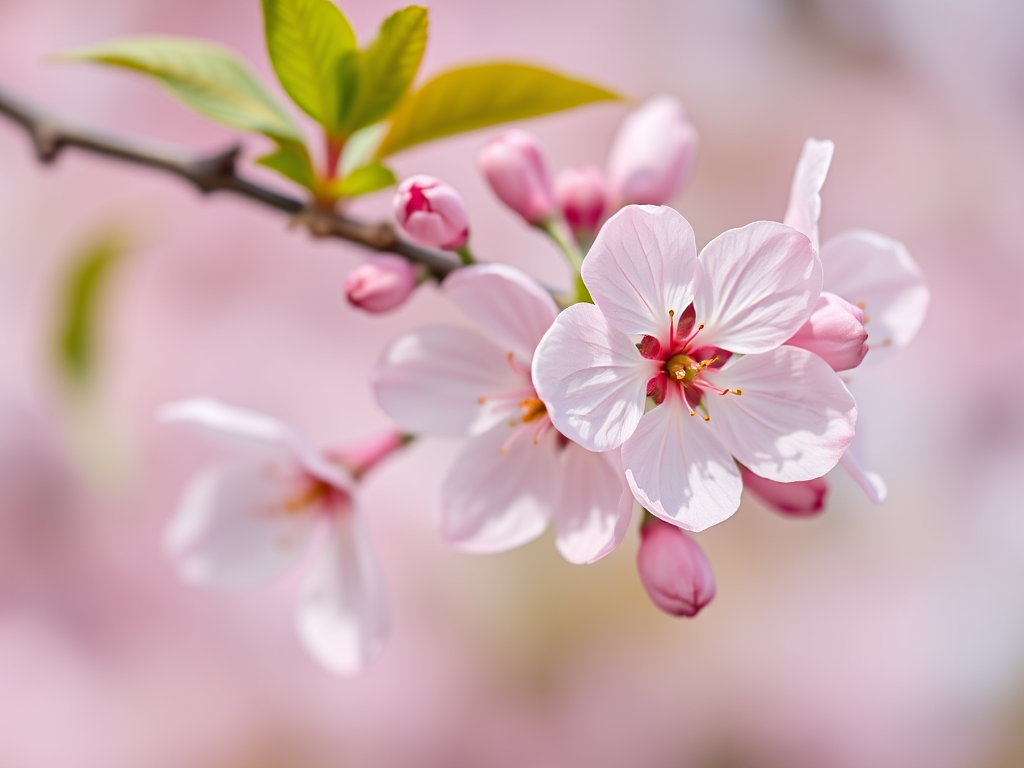
Cherry Blossom: A Meditation on Ten Perfect Days
No other flower commands a calendar the way the cherry blossom does. Meteorological agencies across East Asia publish forecasts for its opening as they would for typhoons; cities schedule festivals around the whims of a tree; office workers plan their lunches beneath branches that will be bare again within a fortnight. All of this ceremony for a bloom that lasts, in any given place, scarcely ten days. The cherry blossom is proof of a paradox we all quietly understand: that brevity is not the enemy of beauty but very nearly its source.
A Family of Early Risers
Botanically, the cherry belongs to the genus Prunus in the rose family, kin to the plum, the peach, and the apricot — a lineage of impatient trees that flower before they bother to leaf. The strategy is pragmatic: petals open to pollinators before the canopy closes and shades them out. But to the human eye the effect is pure theater. A cherry tree in full bloom carries no green at all, only cloud upon cloud of white and palest pink, as if winter itself had crystallized into flower. The famous Yoshino cherry, the variety that lines riversides from Seoul to Washington, produces blossoms so faintly pink they read as white at a distance and blush only when you draw near — a flower that rewards attention, which is perhaps the point of all flowers.
The word itself carries history. The Japanese sakura gave the world its most famous name for the tree; in Korea it is beotkkot, named for the beotji, the small dark cherry that follows the flower. And the tree gave back more than beauty: many of the woodblocks of the Tripitaka Koreana, the thirteenth-century Buddhist canon carved onto more than eighty thousand blocks and preserved for eight centuries, were cut from mountain cherry. The same tree that surrenders its petals in a week yields timber that outlasts empires. Transience and permanence, it turns out, can share a single trunk.
The Philosophy of Falling
It was in Heian-era Japan, over a thousand years ago, that flower viewing — hanami — shifted its devotion from the plum to the cherry, and an aesthetic tradition was born. The Japanese found in the falling petals mono no aware, the gentle ache of things passing; Korean tradition compressed the same insight into a four-character proverb, hwamu-sibilhong: no flower stays red for ten days. In 1912, three thousand cherry trees traveled from Tokyo to Washington as a gesture of friendship, and the meditation went global; every spring since, crowds have gathered at the Tidal Basin to watch, in essence, time itself become visible.
The blossoms do not fall because they are defeated. They fall because they are finished — and there is a difference.
This is the cherry blossom's quiet instruction. It does not cling past its peak. At the very height of its splendor, at the smallest provocation of wind, it lets go — and the letting go becomes its second bloom, the petal-storm the Japanese call hanafubuki, a blizzard of flowers. Poets across centuries have stood beneath it and drawn the same conclusion: that a life, like a blossom, is not measured by its duration but by its fullness, and that knowing when to release something may be the rarest form of grace.
What the Petals Ask of Us
A single cherry blossom is a modest thing — five notched petals, a breath of fragrance, gone in days. Its glory is collective. One flower is a whisper; a hundred thousand on a single tree are a proclamation, and an avenue of such trees can alter the emotional weather of an entire city. There is a human lesson folded into that botany. Our own gestures — a word of congratulation, a note of sympathy, an unprompted reminder that someone is loved — are individually small. Accumulated, they are the canopy under which a life is lived.
And so the season leaves us with its perennial homework: do not postpone. The viewing party delayed by a week arrives to green leaves and bare pavement. The affection deferred until a better moment discovers that moments, like petals, do not wait. The trees will bloom again next year, but the people we mean to cherish are, like us, a year older each spring — and the particular conjunction of this person, this feeling, this April, will not recur.
When the moment to speak arrives, Arrive in Bloom (flowername.co.kr) exists to carry it: each arrangement is handcrafted in our atelier from flowers fresh that same day, delivered nationwide across Korea the very day you order before 2 p.m. (next day for Jeju), finished with complimentary ribbon calligraphy in Korean or English, and confirmed with a photograph upon delivery — with a 24-hour concierge at 1666-6584 standing by, because feelings, like blossoms, keep their own season.
'Flower Stories' 카테고리의 다른 글
| A Flower Made of Mornings: On the Rose of Sharon (0) | 2026.08.19 |
|---|---|
| The Azalea: A Flower That Blooms Before Its Leaves (0) | 2026.08.19 |
| The Quiet Aristocrat: Reading the Orchid (0) | 2026.08.19 |
| The Flower That Rises Clean: A Meditation on the Lotus (0) | 2026.08.18 |
| The Plum Blossom: A Flower That Refuses to Wait for Spring (0) | 2026.08.18 |